Events
- Events
- Seminars
Seminars
- Date
- 2025.12.08
- Writer
- 주송희
- Hit
- 19
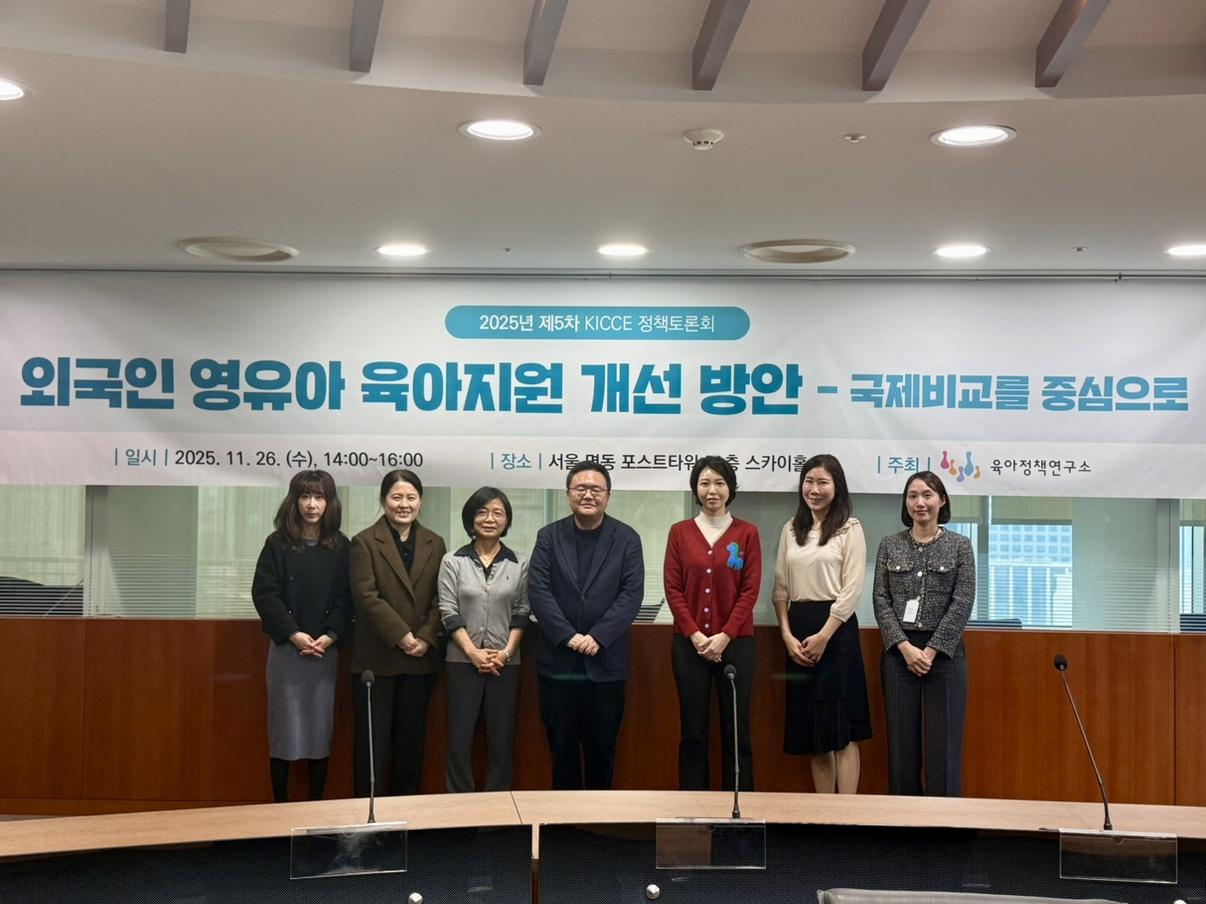
The Korea Institute of Child Care and Education (KICCE) held the “5th KICCE Policy Forum in 2025 – Policy Measures to Improve Childcare Support for Foreign Infants and Young Children: Focusing on International Comparison” on Wednesday, November 26, 2025, from 2:00 p.m. at Sky Hall (21F), Myeong-dong Post Tower (Seoul Central Post Office Building) in Seoul. The forum was organized to review the current status of childcare and care-support policies for foreign infants and young children and their families residing in Korea, and to explore directions for improving Korea’s childcare support system through comparative analysis of policy cases in major countries.
Keun Jin Kim, Research Fellow at KICCE, delivered a presentation titled “Policy Measures to Improve Childcare Support for Foreign Infants and Young Children: Focusing on International Comparison.” The presentation systematically compared and analyzed immigration policies and policy measures in the areas of cash benefits, early childhood education and care, time support for childrearing, and health support in the United Kingdom, Germany, Sweden, and Japan, and drew policy implications for childcare support for foreign infants and young children in Korea.
In the subsequent designated discussion session, Professor Yoonjin Lee (Research Institute for a Healthy Aging Society, Konkuk University) served as chair. The discussants were Professor Kyung-Eun Yang (Department of Social Welfare, Sungkonghoe University), Professor Min-Kyung Lee (Teacher Training Office, College of Education, Daegu University), Senior Research Fellow Young-hye Kim (Gyeonggi-do Women & Family Foundation), and Professor Im Sook Jang (Public Policy Research Center, Pukyong National University). The panel engaged in in-depth discussions from various perspectives, addressing difficulties faced by foreign infants and young children and their families in accessing childcare and early childhood education services, tailored support for multicultural and migrant-background families, and ways to strengthen linkages with local communities.
In the final general discussion, participants agreed on the importance of establishing a more comprehensive and effective childcare support system so that foreign infants and young children and their families can grow and settle safely and stably in Korean society.